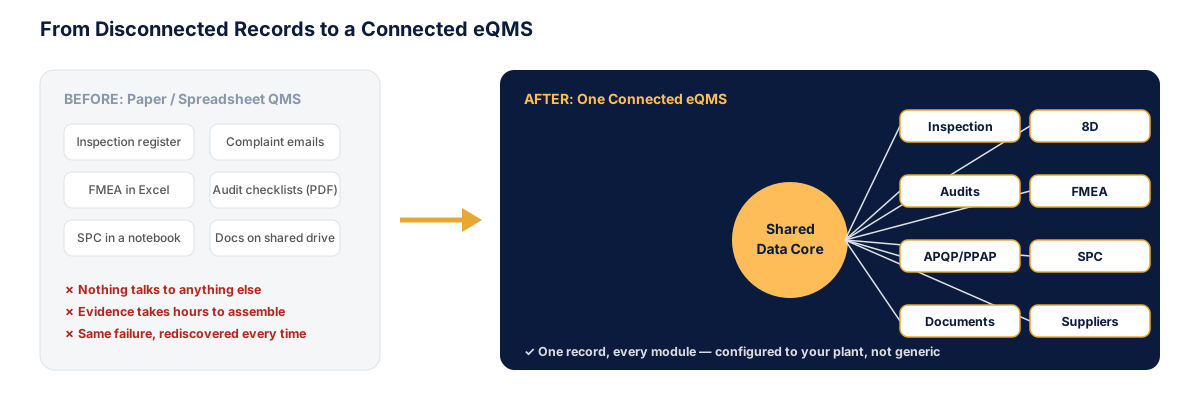
An eQMS (electronic Quality Management System) digitizes and connects the processes a traditional QMS runs on paper or in scattered spreadsheets — inspection, complaints, audits, FMEA, documents, supplier quality — into one shared system where every module talks to the others. It matters because disconnected quality data is slow to retrieve, easy to fake accidentally, and impossible to learn from at scale. FAST Quality is built as a genuine eQMS: AI-assisted 8D root cause analysis, workflows configured to your plant instead of generic templates, and eleven modules sharing one data core.
What eQMS Actually Means
Strip the acronym down and it says exactly what it is: electronic Quality Management System. Not "a QMS with a login page" — a system where the quality processes that used to live in registers, binders and someone's inbox now live as connected, auditable, electronic records. If you want the fuller picture of what a QMS itself covers, our QMS fundamentals guide is the companion piece to this one.
The "electronic" part is doing more work than it looks like. It's not just storage — paper filed in a cabinet is "stored" too. It's three specific properties: traceable (every record has a who/when/what), connected (one module's output is another's input, automatically), and retrievable (any record, in seconds, not a filing-cabinet hunt).
Why "QMS Software" and "eQMS" Aren't Always the Same Thing
Here's the part vendors don't love pointing out: a lot of "QMS software" is a document repository with a quality-shaped skin on it. You upload your inspection forms as PDFs, your FMEA as an attached spreadsheet, your audit checklist as a scanned image. Technically electronic. Not actually an eQMS — because none of it talks to the others, and you're still manually re-typing the same characteristic into three different places.
A genuine eQMS has data flowing between modules without a human copying it: a special characteristic identified in FMEA automatically becomes a line in the control plan and checksheet; a customer complaint opens an 8D that can pull the exact inspection record from the day the part shipped; an audit finding creates a CAPA that's visible to the document owner without anyone forwarding an email. If your evaluation of an "eQMS" doesn't include watching data move between two modules live, you're evaluating a document store.
Why eQMS Matters in Manufacturing Right Now
- The cost of poor quality is brutal and hidden. Scrap, rework and warranty typically erode 5-30% of revenue in manufacturing — and most of that cost is invisible until someone digitizes it. See our COPQ breakdown.
- Standards increasingly assume digital evidence. IATF 16949 audits, AS9100, ISO 13485 — and in India specifically, SAMAR — all score how fast and completely you can produce records. "We have a register" is a Level 2 answer; "here's the record in nine seconds" is Level 4.
- Speed to root cause is now a competitive metric. Customers measure supplier response time on complaints. An 8D that takes three weeks because nobody can find the batch history loses business that a connected system wouldn't.
- Quality data is only intelligence if it's connected. A thousand inspection records in a thousand separate files are a thousand facts. The same thousand records in one system are a capability trend, a supplier risk score, and an early warning — the entire value of SPC depends on this.
The Two Gaps Most eQMS Platforms Leave Open
Having implemented and audited more of these systems than I can count, the pattern repeats: platforms that digitize records well still leave two very expensive gaps open.
Gap 1 — root cause analysis is still 100% manual. The software stores the 8D beautifully. It does nothing to help the engineer staring at a defect they've genuinely never seen connect it to the failure mode that caused it three plants and two years ago.
Gap 2 — every plant gets the same generic workflow. A pharma batch record process and an automotive stamping line do not run the same way, but a lot of "configurable" platforms mean "you can rename our fields," not "the workflow actually matches how your operators work."
These aren't small gaps — they're the two places where an eQMS either earns its keep or becomes an expensive filing cabinet. Here's how we've approached both.
AI-Assisted 8D: What It Actually Does
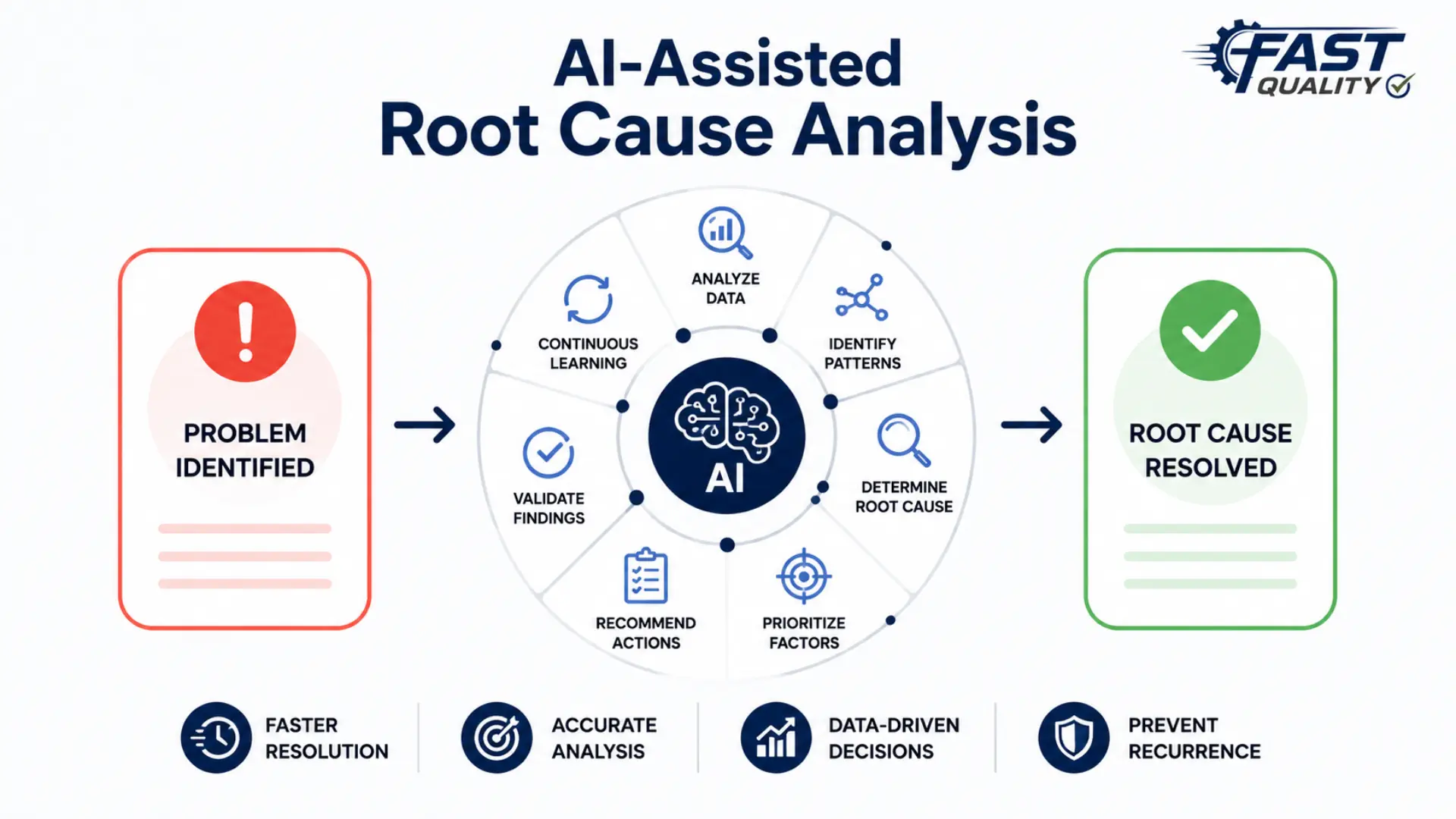
To be precise about what "AI-assisted" means in FAST Quality's 8D module, because vague AI claims are cheap and specific ones are useful:
- Pattern matching against historical failures — when a new complaint comes in, the system surfaces similar past failure modes, their confirmed root causes, and what corrective actions worked, instead of the team starting D4 from a blank page.
- Predictive complaint detection — trend signals across inspection and process data flag emerging failure patterns before they turn into a customer complaint at all.
- Automated 8D report generation — once the team's findings are entered, the customer-facing 8D report assembles itself, instead of costing an engineer half a day of formatting.
- Real-time WhatsApp escalation — containment and closure deadlines that slip trigger alerts to the right person immediately, on the channel Indian plant teams actually respond to.
None of this replaces the 5-Why or the engineer's judgment — see our honest take on that discipline in the 8D problem-solving guide. What it replaces is the twenty minutes of "have we seen this before?" that every investigation starts with.
Configured Workflows, Not Generic Templates
The second gap — generic workflows — is why FAST Quality is built module-by-module around what each industry actually audits against, not a single one-size-fits-all form. A pharma customer's deviation workflow reflects GMP and 21 CFR Part 11 expectations; an automotive customer's nonconformance workflow reflects IATF 16949 and the control-plan chain; a defence supplier's evidence structure reflects SAMAR disciplines. Same underlying platform, different configured behaviour — see how this plays out per industry on our automotive, pharma and defence pages.
Practically, "configured" means: your approval chains, your escalation rules, your inspection sampling plans, and your document numbering convention are set up during implementation to match how your plant already makes decisions — not the other way around, where your team learns to work around the software's defaults.
Why Manufacturers in India Choose FAST Quality
Being specific instead of superlative:
- Proof, not promises, in defence-grade environments. FAST Quality software runs at ITR (Integrated Test Range), Chandipur — a DRDO establishment — supporting SAMAR readiness through digital inspection, calibration and audit records. Read the SAMAR page.
- Measured customer outcomes. Customers report up to 94% fewer escaped defects, 6x faster audit preparation, 80% less manual quality work and 3x faster CAPA closure — see customer results.
- Modular pricing that doesn't force a six-figure commitment. You license the modules you need and add more as maturity grows — a genuinely different model from the enterprise eQMS platforms compared on our ETQ and MasterControl comparison pages.
- Support in your timezone, in your language. Implementation and support run from Pune, not a support queue eight time zones away.
How to Evaluate Any eQMS (Not Just Ours)
Whichever platform you're considering, ask these questions in the demo — and insist on seeing the answer live, not on a slide:
- Show me a change propagating. Edit a special characteristic in FMEA — does the control plan actually update, or do you re-enter it by hand?
- Show me an 8D that pulls its own evidence. Can the system retrieve the inspection record for the shipped lot without someone searching a shared drive?
- Ask what "configurable" means precisely. Renaming a field is not the same as matching your approval chain and escalation rules.
- Ask for a reference in your industry. A pharma reference tells you nothing about automotive core-tools depth, and vice versa.
- Price the whole rollout, not just the license. Implementation, training and support often cost more than the software — get all three quoted together.
An eQMS is a long-term commitment — evaluated well once, it pays for itself in the audits that stop being stressful and the complaints that stop repeating.

Dhanashree Kathare
Co-Founder, FAST Technology — writes about practical quality engineering for manufacturing teams.
Connect on LinkedIn