8D (Eight Disciplines) is a structured problem-solving method for resolving quality issues permanently: form a team, describe the problem factually, contain it, find and verify the root cause, implement corrective actions, prove they work, and prevent recurrence by updating FMEA and control plans. It is the standard customer-complaint format in automotive and demanded across manufacturing.
When to Use 8D (and When Not To)
8D earns its overhead when the cause is unknown, the problem is recurring or customer-facing, and a cross-functional fix is likely. For a one-off operator slip with an obvious cause, a simple corrective action is enough — running everything through 8D breeds paperwork fatigue and shallow analysis. Many customers mandate the 8D format for every formal complaint; internally, reserve it for problems worth eight disciplines of attention.
The 8 Disciplines, Step by Step
D0 — Prepare and protect
Before the formal process: assess the symptom and, if customer risk exists, act immediately — don't wait for the team to form.
D1 — Form the team
Small (3–6 people), cross-functional, with real process knowledge and a champion who can unblock resources. A quality engineer alone is not a team.
D2 — Describe the problem
Facts only, quantified: which part, which operation, which shift, how many, since when. The Is/Is-Not table is the strongest tool here — what is affected and, just as important, what isn't.
D3 — Interim containment
Protect the customer while you investigate: sort stock at every stage (line, warehouse, transit, customer), certify outgoing parts, and mark contained stock. Verify containment actually works — a leaking containment is a second complaint waiting.
D4 — Root cause analysis
Find two root causes, not one: the technical cause (why the defect occurred) and the escape cause (why your system didn't catch it). Use 5-Why or fishbone, then verify — can you switch the problem on and off by manipulating the cause? Unverified root causes are guesses.
D5 — Choose permanent corrective actions
Prefer error-proofing (poka-yoke) over instructions and training, which decay. Pilot the action and confirm it eliminates the cause without side effects.
D6 — Implement and validate
Roll out, then watch the data long enough to prove recurrence is gone — only then remove containment.
D7 — Prevent recurrence systemically
Update the PFMEA, control plan and work instructions; check sister parts and similar processes for the same failure mode. This is the discipline that separates plants that learn from plants that repeat.
D8 — Close and recognize
Formal closure with the customer, and genuine recognition for the team — the cheapest investment in wanting to do the next 8D properly.
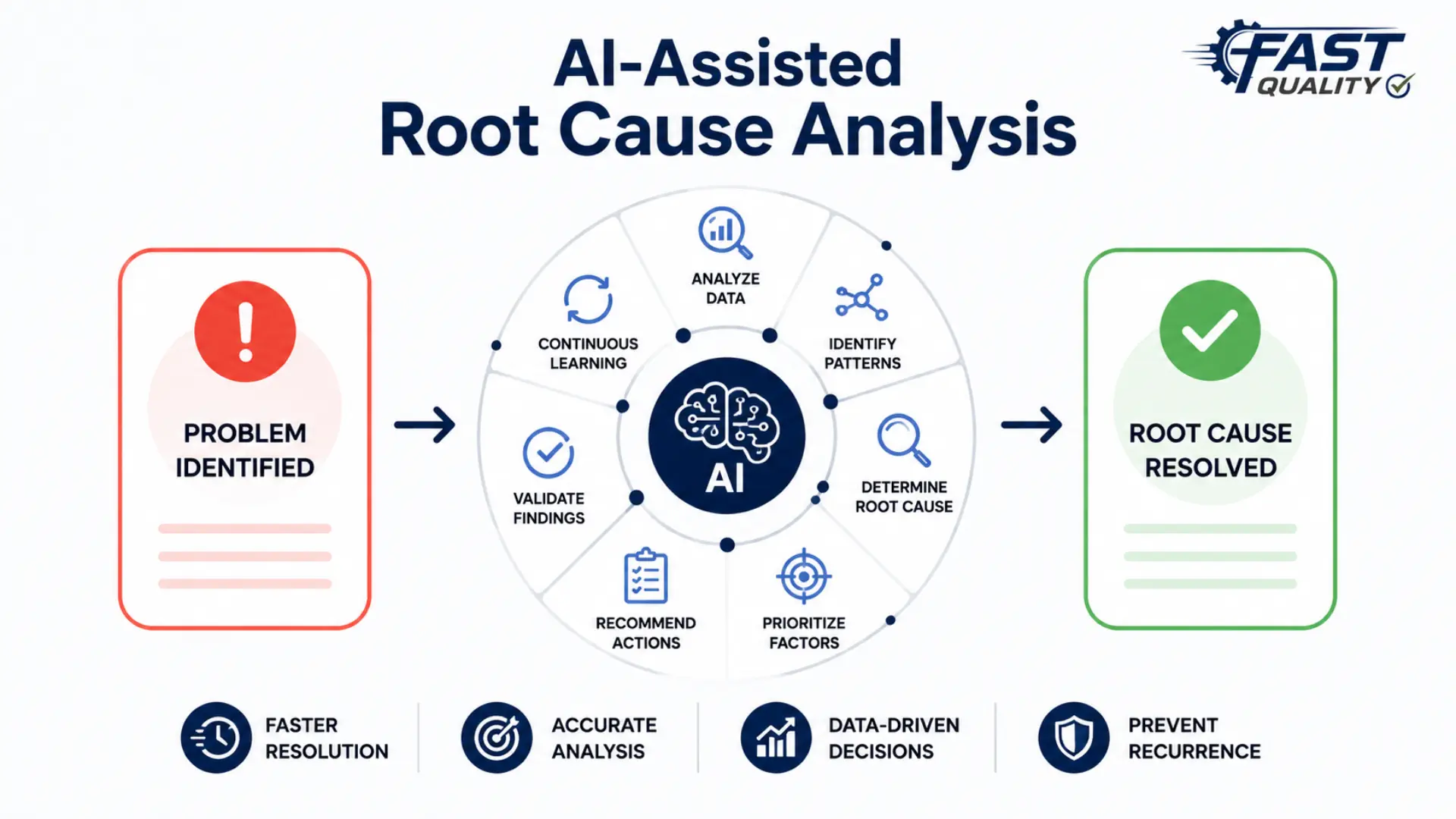
A Worked Example
Problem (D2): Customer reports 14 connector housings with cracked snap-fits from lot 2205, all from cavity 3 of tool T-118; cavities 1, 2, 4 unaffected; no complaints in prior 12 lots.
Containment (D3): 100% sort of lot 2205 at customer and in warehouse (3 more found, all cavity 3); cavity 3 blocked from packing.
Root cause (D4): Technical — cavity 3 cooling channel partially blocked, raising local mold temperature and creating a brittle weld line. Escape — visual inspection cannot see weld-line embrittlement; no cavity-level SPC on the dimension that shifted.
Corrective action (D5/D6): Cooling channel cleaned and flow-monitored with alarm; cavity-level dimensional SPC added; weld-line strength added to setup approval. Data over 20 lots: zero recurrence; containment lifted.
Prevention (D7): PFMEA updated with cooling-failure mode across all multi-cavity tools; tool maintenance plan now includes flow verification — pushed to the maintenance system.
Why Most 8Ds Fail
- Root cause = "operator error." A person is never a root cause; ask why the system allowed the error.
- D4 written to satisfy the customer deadline — an unverified cause, so the problem returns in six months.
- Containment becomes permanent. If 100% sorting still runs after closure, D5–D6 never actually happened.
- D7 skipped entirely. The FMEA and control plan stay unchanged, so sister processes repeat the failure.
- No deadlines or ownership — the 8D dies in a shared spreadsheet.
Running 8D Digitally
The discipline that makes 8D work — owners, deadlines, verification evidence, linked FMEA updates — is exactly what spreadsheets don't enforce. Dedicated 8D complaint management software assigns each discipline with deadlines and escalations (in FAST Quality, over WhatsApp — where plant teams actually respond), keeps containment and verification evidence attached to the case, generates the customer-format 8D report automatically, and closes the loop into FMEA and control plans so D7 actually happens.

Dhanashree Kathare
Co-Founder, FAST Technology — writes about practical quality engineering for manufacturing teams.
Connect on LinkedIn