A Quality Management System (QMS) is the formal structure of processes, procedures, records and responsibilities a manufacturer uses to consistently meet customer and regulatory requirements. QMS software digitizes that structure — inspections, complaints, audits, FMEA, documents and corrective actions — into one connected, auditable platform.
What a QMS Actually Is
Every manufacturer already has a quality management system — even if it lives in registers, Excel sheets and the plant manager's memory. The QMS is simply the answer to four questions: What do we check? How do we react when something fails? Who is responsible? And can we prove all of it to a customer or auditor?
A formal QMS writes those answers down as controlled processes: quality plans, inspection standards, complaint handling procedures, audit schedules, document control rules and corrective action workflows. ISO 9001 is essentially a checklist for whether those answers exist and are followed.
Paper QMS vs QMS Software
The difference is not the quality system itself — it is how much of your team's time goes into feeding it, and how much truth it tells.
| Activity | Paper / Excel QMS | QMS Software |
|---|---|---|
| Inspection records | Handwritten checksheets, transcribed later — transcription errors common | Captured at the station, instrument readings flow in directly |
| Customer complaint | Email threads; 8D discipline depends on individuals | Structured 8D workflow with owners, deadlines and escalations |
| Audit preparation | Days or weeks assembling evidence from cupboards | Records already organized and searchable — audit-ready by default |
| Trend visibility | Monthly, if someone builds the spreadsheet | Live dashboards, SPC control charts and automatic alerts |
| Document control | Obsolete revisions circulate on the shop floor | One controlled source with approval and revision history |
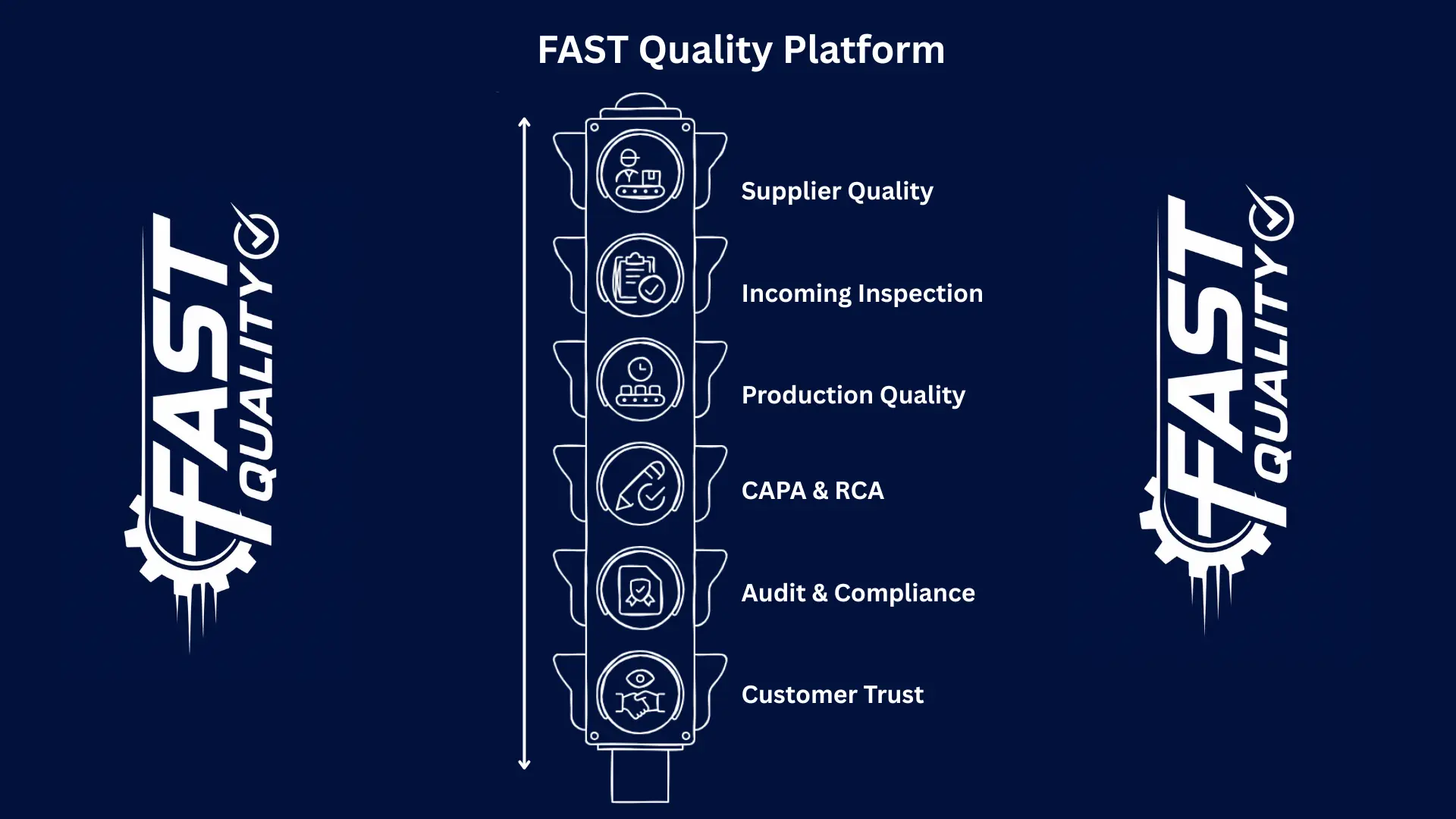
The 8 Core Components of QMS Software
1. Quality planning and inspection
Control plans and inspection standards defined once, then executed consistently at inward, in-process and finished-goods stations. This is usually the first module plants deploy — see quality planning & inspection software.
2. Complaint management and CAPA
Structured problem solving — typically 8D — with root cause analysis, containment, corrective actions and effectiveness verification.
3. Audit management
Internal, process, product and supplier audits: scheduling, qualified auditor assignment, checklist execution, nonconformity tracking and closure.
4. Risk management (FMEA)
DFMEA and PFMEA identify where failures can occur and prioritize prevention — under AIAG-VDA, using Action Priority rather than legacy RPN.
5. New product quality (APQP / PPAP)
APQP plans quality into the launch; PPAP proves production readiness to the customer with up to 18 evidence elements.
6. Measurement integrity (MSA) and process control (SPC)
Gage R&R studies confirm you can trust your measurements; SPC confirms the process stays capable between inspections.
7. Document control
Controlled creation, approval, distribution and retirement of every quality document — the backbone auditors check first.
8. Supplier quality
Supplier ratings, incoming inspection, supplier 8D and supplier PPAP — because your quality is only as good as your worst supplier.
QMS and Standards: ISO 9001, IATF 16949 and Beyond
Standards define what your quality system must achieve; QMS software is how you operate and evidence it daily:
- ISO 9001:2015 — the baseline QMS standard for any manufacturer.
- IATF 16949:2016 — automotive; adds APQP, PPAP, FMEA, MSA and SPC as expected core tools.
- AS9100 Rev D — aerospace; adds first article inspection and FOD control.
- ISO 13485 / FDA 21 CFR 820 — medical devices; device history records and design controls.
- GMP / 21 CFR Part 11 — pharma; electronic batch records and audit trails.
- SAMAR — the assessment framework for India's DRDO-linked defence production units.
What Changes When Quality Goes Digital
Manufacturers that digitize typically see three shifts. First, data becomes trustworthy — readings come from instruments, not transcription. Second, reaction time collapses — a failed inspection triggers containment the same hour, not at month-end review. Third, audit anxiety disappears — evidence accumulates as a by-product of daily work. FAST Quality customers report up to 94% fewer escaped defects and audit preparation six times faster (see customer results).
How to Choose QMS Software
- Match modules to your pain, not the brochure. If complaints hurt most, start with 8D; if launches hurt, start with APQP/PPAP.
- Check methodology depth. Ask to see AIAG-VDA FMEA, all 18 PPAP elements and MSA-4 studies actually running — not roadmap slides.
- Insist on shop-floor data capture. If operators must type readings into a laptop, adoption dies. Instrument and barcode integration is non-negotiable.
- Evaluate the implementation, not just the software. Training, data migration and a named success manager decide whether the system is used a year later.
- Confirm deployment fit. Cloud for speed and automatic updates; on-premise where data residency rules demand it.

Dhanashree Kathare
Co-Founder, FAST Technology — writes about practical quality engineering for manufacturing teams.
Connect on LinkedIn