FMEAs fail for practical, fixable reasons: they start after the design is frozen, one engineer writes them alone, functions are never defined, ratings get negotiated instead of evidenced, actions expire in a forgotten column, the FMEA never meets the control plan, and nobody reopens it after field failures. The fixes are organizational, not technical.
Here's a test I do in almost every plant I visit: I ask to see the PFMEA for their highest-scrap process, then I ask one question — "when did this document last change anything?" Not "when was it last revised" (usually before an audit). When did it last change a design, a fixture, a parameter, a checksheet? The silence that follows is the sound of an FMEA on a shelf. Seven reasons it got there, and how to get it down.
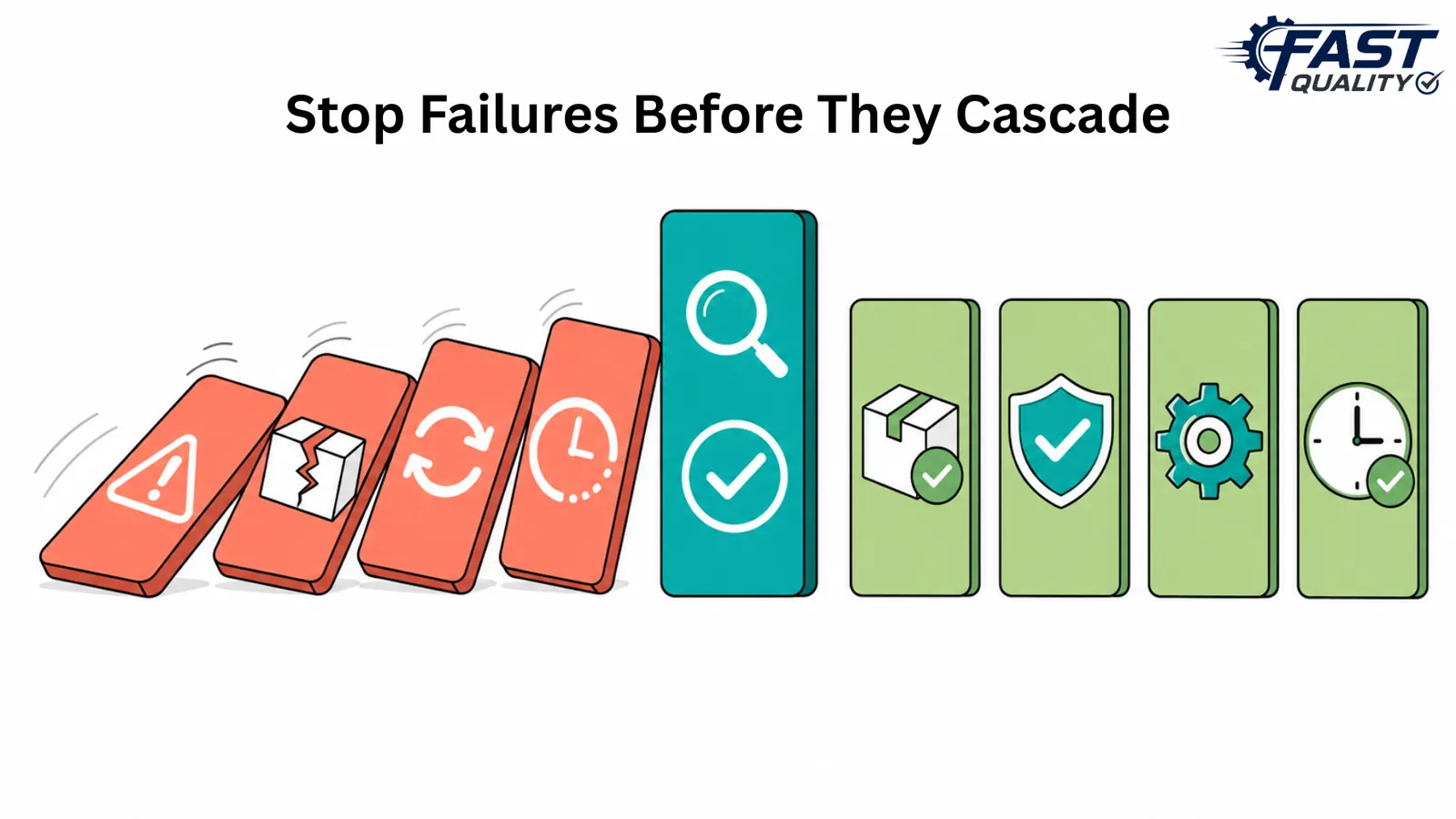
Mistake 1: Started Too Late
An FMEA created after design freeze (or after the line is installed) can only document risk, not remove it — every fix now costs tooling money. You can smell this in the recommended-actions column: when most actions say "add inspection," the analysis came too late to prevent anything, so it defaulted to detection.
Fix: tie FMEA start dates to APQP phases and make them gate evidence — DFMEA drafted before design freeze, PFMEA before equipment procurement. Late FMEA is an APQP planning failure, and it's cheaper to fix there.
Mistake 2: Written Alone
One quality engineer, one late evening, one template from the last project. The result reads fine and knows nothing — the operator who has watched parts jam a certain way, the maintenance fitter who knows which axis drifts, the designer who knows which tolerance is fragile were all absent.
Fix: 4-7 people, short sessions (90 minutes beats a full-day marathon), and a facilitator who runs the method so the experts can think. Cheapest quality investment there is: the knowledge already exists in your plant; the FMEA meeting is just where it gets written down.
Mistake 3: No Functions, Only Failures
Teams that skip structure and function analysis (steps 2-3) brainstorm failures from memory — and memory produces last year's problems, not next year's. Without a function ("deliver 25±3 Nm clamp load"), a failure mode is just a complaint ("bolt loose").
Fix: insist on the 7-step order. Functions with numbers first; failures as their negation. It feels slower and finds roughly twice as much — every workshop, same result.
Mistake 4: Negotiated Ratings
"Let's call Occurrence a 3, we've never seen it fail." (The line is two months old.) Ratings drift toward whatever keeps the number below the action threshold — the disease that killed RPN and can infect Action Priority too if the culture doesn't change.
Fix: ratings cite evidence or they don't count. Occurrence points to prevention controls you can show; Detection points to a method that exists at a station that exists. And a High AP is a work item, not a shame item — teams only stop negotiating when a bad rating stops being a punishment.
Mistake 5: The Action Graveyard
The recommended-actions column is where FMEAs most often die: no owner, no date, no follow-up, and the original analysis grows stale above it. Two years later, half the "current controls" don't exist anymore.
Fix: FMEA actions live in the same action-tracking system as your 8D and audit actions — owners, dates, escalations, and closure requires re-rating the chain with the new evidence. This one is squarely a systems problem: software that escalates beats a spreadsheet that waits.
Mistake 6: The FMEA Never Meets the Control Plan
PFMEA says the seal orientation is critical, control plan doesn't check it, checksheet has never heard of it. Three documents describing the same process — none agreeing. This is among the most cited automotive audit findings, precisely because it's so easy to check.
Fix: one linked chain — failure cause → control → control plan line → checksheet item — maintained as a relationship, not as three files to remember to update together. When the FMEA changes, the downstream documents must change or block. (This is the single strongest argument for taking FMEA out of Excel.)
Mistake 7: The FMEA Never Hears About Failures
A customer complaint arrives; an 8D runs; the problem is fixed. And the PFMEA — which rated that exact failure cause Occurrence 2, Detection 2 — is never told. The document that exists to predict failures doesn't learn from the ones that happen.
Fix: make "update the FMEA" a mandatory 8D closure step (that's D7 prevention, done properly) and run a periodic review that reconciles FMEA ratings against actual complaint and scrap data. An FMEA that learns is the difference between a living risk analysis and a museum exhibit.
Get the Complete FMEA Checklist (AIAG-VDA 7 Steps)
A step-by-step workbook for running DFMEA and PFMEA per the AIAG-VDA handbook — planning 5T, structure and function prompts, failure-chain quality checks, AP follow-up and review-readiness questions. Delivered free on WhatsApp.
Send Me the Checklist Or Request It by EmailThe Pattern
Notice that none of the seven mistakes is about severity scales or form columns. FMEA fails as an organizational practice: started late, staffed thin, disconnected from actions, documents and field reality. Fix the organization around the method — timing, team, evidence, links, feedback — and even an average FMEA finds problems worth ten times the meeting cost. Keep the method sharp with the 7-step guide and the checklist above.

Dhanashree Kathare
Co-Founder, FAST Technology — writes about practical quality engineering for manufacturing teams.
Connect on LinkedIn