APQP runs in five overlapping phases: (1) Plan and Define the program, (2) Product Design and Development, (3) Process Design and Development, (4) Product and Process Validation, and (5) Feedback, Assessment and Corrective Action. Each phase has defined inputs and outputs, and the outputs of one phase are the inputs of the next.
I've sat through more APQP kick-offs than I can count, and the pattern is always the same: everyone nods at the five-phase chart, and three months later the program is being run out of one engineer's inbox. So this walkthrough isn't the textbook version — it's the five phases as they actually play out in a plant, with the deliverables that matter and the moments where programs quietly go wrong.
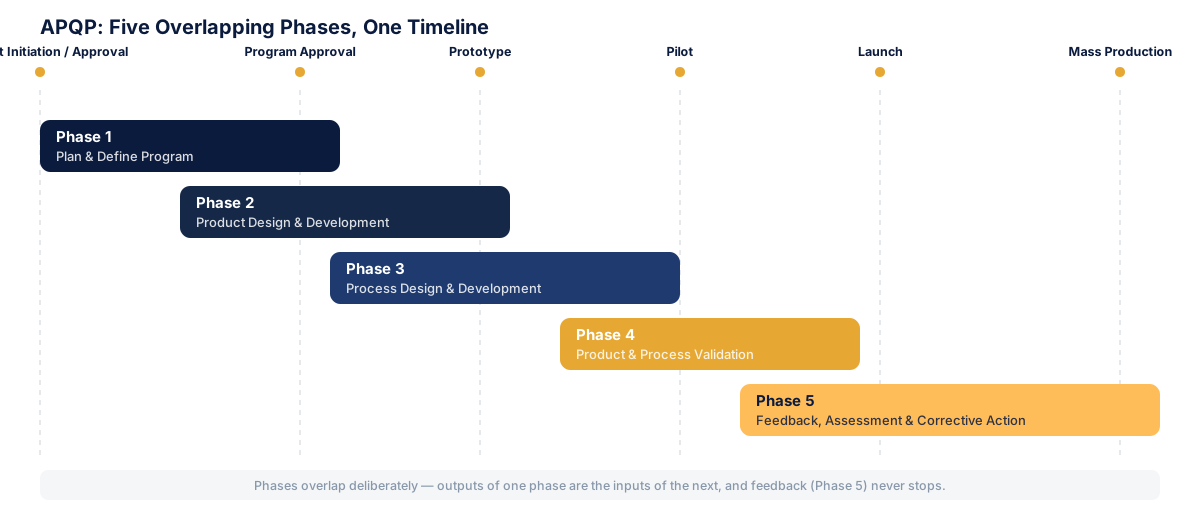
Phase 1 — Plan and Define: Where Programs Are Won
Phase 1 answers one question: do we truly understand what we're signing up for? The inputs are voices — the customer's (market research, warranty history, complaint data), the business's (volumes, margins, timing) and the benchmark's (what the best competitor part looks like). The outputs turn those voices into numbers: design goals, reliability and quality targets, a preliminary bill of material, a preliminary process flow, and the first list of special characteristics.
The 3rd Edition quietly made Phase 1 the hardest-working phase in the manual. It now expects capacity planning (can you actually make this volume?), a risk assessment and mitigation plan (what could sink this program?), program metrics (how will we know we're on track?) and explicit leadership support. That's not bureaucracy — it's every painful launch lesson of the last twenty years written into the standard.
A tier-2 supplier we worked with won a bracket program at a price that assumed 78% OEE on a line already running at 71%. Nobody checked capacity in Phase 1. They spent eighteen months paying premium freight to air-ship parts they were making on weekends. Capacity planning isn't a form — it's arithmetic that saves careers.
Phase 2 — Product Design and Development
The design phase belongs to the problem-finders, not just the designers. The DFMEA asks "how could this design fail?" while changes still cost nothing. Design reviews and the design verification plan keep optimism in check. Outputs: drawings and specs, prototype build control plan, equipment and gauge requirements, and the list of special characteristics that will follow the part for the rest of its life.
The phase ends with the team feasibility commitment — manufacturing's signature that says "yes, we can build this." Treat that signature like a bank guarantee, because your customer will.
Phase 3 — Process Design and Development
Now flip the drawing over and design the factory's side: process flow chart, floor plan, and the PFMEA — which should inherit failure modes from the DFMEA, not be written from a blank sheet. The pre-launch control plan and process instructions translate the engineering into what an operator actually sees at the station. Two quiet deliverables here decide Phase 4's fate: the MSA plan (which gauges need studies) and the preliminary capability study plan (which characteristics get charted, and how many parts).
The fastest PFMEA review I ever run: take the process flow chart to the floor and follow one part physically. Every place the part waits, turns, or changes hands that isn't on the chart is a failure mode the PFMEA has never heard of. I have never once come back from that walk without additions.
Phase 4 — Product and Process Validation: Proof, Not Promises
Everything so far was planning. Phase 4 is evidence: a significant production run — real tooling, production operators, production rate — feeding the MSA studies, the preliminary capability studies, production validation testing and packaging evaluation. The evidence rolls up into PPAP, and if your customer approves, the production control plan takes over — now with Safe Launch provisions (extra containment and inspection during early builds) per the new Control Plan manual.
The honest test of Phase 4: could you show an auditor, today, the run data, the Gage R&R results and the Cpk numbers behind your PSW — in minutes, not days? If the answer is a shared-drive treasure hunt, the validation happened but the evidence system didn't.
Phase 5 — Feedback: The Phase Everyone Skips
Production starts, the team dissolves, and the manual's fifth phase — reduced variation, customer satisfaction, delivery performance, lessons learned — becomes a slide nobody presents. Which is a shame, because Phase 5 is where the next program's Phase 1 gets its best inputs. The discipline is simple: hold the lessons-learned review within 90 days of launch, write the lessons into your FMEAs and checklists (not a slide deck), and track variation with live SPC instead of monthly summaries.
Get the Complete APQP Checklist (3rd Edition)
Every phase, every deliverable, every gate — a phase-by-phase workbook with owner and status columns, aligned to the 2024 3rd Edition (including the new Phase-1 items and Safe Launch). Delivered free on WhatsApp.
Send Me the Checklist Or Request It by EmailThe Uncomfortable Summary
APQP fails as paperwork and works as a conversation with a calendar. Five phases, each with inputs, outputs and a gate decision — and each one cheaper than discovering the same problem a phase later. If your team knows the five phases but your launches still hurt, the next article is for you: Why APQP fails in real plants — and how to fix it.

Dhanashree Kathare
Co-Founder, FAST Technology — writes about practical quality engineering for manufacturing teams.
Connect on LinkedIn