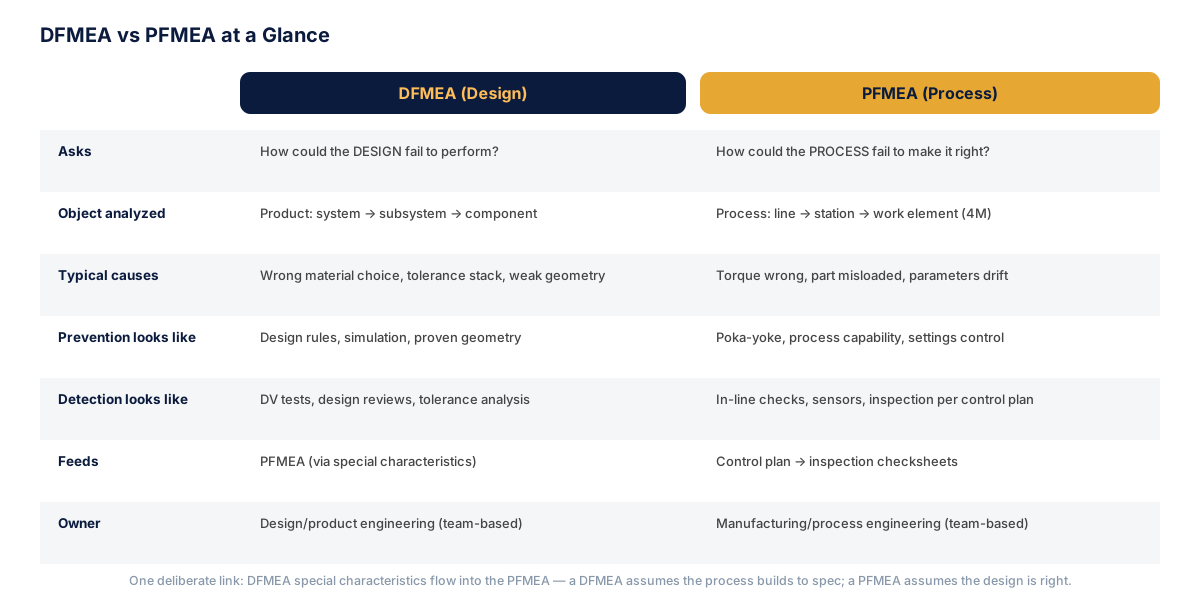
DFMEA analyzes how a product's design could fail to perform its functions, assuming it is built to specification. PFMEA analyzes how the manufacturing process could fail to build the product correctly, assuming the design is correct. DFMEA is owned by design engineering and prevents design weaknesses; PFMEA is owned by manufacturing and prevents production defects — and DFMEA special characteristics flow into the PFMEA.
"Is this a DFMEA thing or a PFMEA thing?" is the most-asked question in every FMEA workshop I run — usually about twenty minutes in, when someone raises porosity in a casting. (Answer at the end. Have a guess.) The distinction is genuinely simple once you hold onto one idea: each analysis assumes the other one did its job.
The One Idea That Untangles Everything
The DFMEA asks: if we build exactly what the drawing says, can the design still fail the customer? Wrong material spec, tolerance stack that binds, snap-fit too weak for the service life — design failures.
The PFMEA asks: if the design is perfect, can our process still ship a bad part? Under-torqued joint, part loaded backwards, oven profile drifting — process failures.
Hold those assumptions and the borderline cases mostly resolve themselves. Lose them, and your DFMEA fills up with operator errors while your PFMEA argues about wall thickness.
DFMEA in Practice
The structure tree is the product: system → subsystem → component. Functions are the product's jobs, with numbers ("retain clamp load 25±3 Nm through 10-year service life"). Failure causes live in the level below the focus element; prevention controls are design rules, simulation, proven geometry; detection controls are the design verification tests and reviews that catch problems before production release.
Timing is everything: a DFMEA that starts after design freeze is an autopsy. Start it when concepts are still cheap to change, during APQP Phase 2.
PFMEA in Practice
The structure tree is the process: process → process steps (stations) → work elements, found with the 4M (man, machine, material, method). Functions are what each step must achieve ("drive screw to 4.5±0.4 Nm in ≤3 s"). Prevention looks like poka-yoke, capable equipment and controlled settings; detection looks like in-line sensors, checks and inspection per the control plan.
The PFMEA is also where the paper meets the shop floor: its outputs literally become the control plan and inspection checksheets. If your PFMEA says a torque is critical and your checksheet doesn't check it, an auditor will connect those two documents faster than you can.
The Handshake: How They Connect
- Special characteristics flow down. What the DFMEA marks as critical for function or safety arrives in the PFMEA as a characteristic the process must control — this is the formal handshake between design and manufacturing.
- Severity aligns. For effects that reach the end user, the PFMEA inherits the DFMEA's severity for the same effect — the plant doesn't get to decide a safety effect is a 6.
- Assumption failures cross over. When the process genuinely can't hold the design's tolerance, that's not a PFMEA action — it's feedback to the design team, and the honest resolution happens in a design review, not in a quietly widened process spec.
Five Borderline Cases, Resolved
| Case | Where it belongs | Why |
|---|---|---|
| Casting porosity | Both — different chains | DFMEA: is the design tolerant of the porosity level the process spec allows? PFMEA: can the process exceed that allowed level (degassing, temperature drift)? |
| Operator installs seal inverted | PFMEA — and DFMEA | PFMEA owns the error and its controls (poka-yoke). The DFMEA question: why does the design permit inverted assembly at all? Best fix is asymmetric design. |
| Material corrodes in service | DFMEA | Wrong material selection for the environment — a design decision, even though the failure appears years later. |
| Wrong material delivered/used | PFMEA | The spec was right; the process (material handling, verification) failed to use it. |
| Weld strength varies | Both | DFMEA: is the joint design robust to the specified weld class? PFMEA: can the process hold the weld parameters that deliver it? |
Get the Complete FMEA Checklist (AIAG-VDA 7 Steps)
A step-by-step workbook for running DFMEA and PFMEA per the AIAG-VDA handbook — planning 5T, structure and function prompts, failure-chain quality checks, AP follow-up and review-readiness questions. Delivered free on WhatsApp.
Send Me the Checklist Or Request It by EmailSo — porosity? Both, and now you can say why. If your team still argues these cases weekly, the fix is usually not more debate but better structure and function analysis up front: see the 7-step walkthrough, or how FAST FMEA software keeps DFMEA and PFMEA linked without the copy-paste.

Dhanashree Kathare
Co-Founder, FAST Technology — writes about practical quality engineering for manufacturing teams.
Connect on LinkedIn