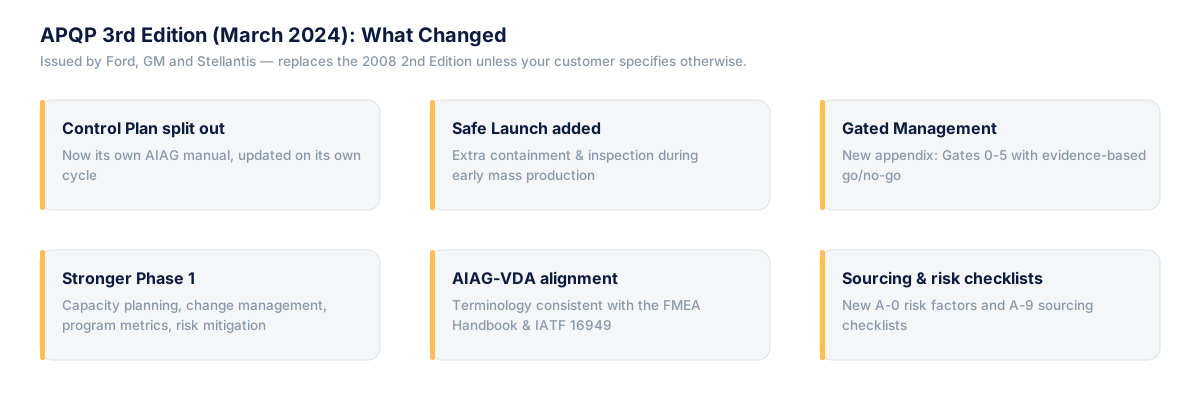
The APQP 3rd Edition (effective 1 March 2024, issued by Ford, GM and Stellantis via AIAG) split the Control Plan into its own manual, added a Safe Launch requirement for early production, introduced a Gated Management appendix (Gates 0-5), strengthened Phase 1 with capacity planning, change management, program metrics and risk mitigation, and aligned terminology with the AIAG-VDA FMEA Handbook and IATF 16949. It replaces the 2008 2nd Edition unless your customer specifies otherwise.
Sixteen years passed between the 2nd Edition (2008) and the 3rd (March 2024). In that time we got the AIAG-VDA FMEA Handbook, IATF 16949, electrification, and a decade of launch failures with well-documented root causes. The 3rd Edition is those lessons, standardized. Here's what changed, why it changed, and — the part most articles skip — what you should actually do about it.
1. The Control Plan Gets Its Own Manual
The biggest structural change: APQP and Control Plan are no longer one book. The Control Plan now has its own AIAG reference manual, on its own update cycle. AIAG's stated reason is speed — control plan practice evolves faster than the planning framework around it.
What it means for you: your document register, training materials and audit references that cite "APQP manual, control plan section" now point at the wrong book. Update the references, and expect customer auditors to ask which control plan edition you work to.
2. Safe Launch — the Change Your Launch Team Will Feel
The Production Control Plan now carries a Safe Launch expectation: during initial mass production, you run more control than the steady-state plan — extra inspection frequency, additional containment, tighter reaction plans — and you exit Safe Launch based on evidence (defect-free runs, stable capability), not on the calendar.
What it means for you: launch quality staffing and budget must be planned in Phase 1, not improvised in week two of production. If you already run GP-12 / early production containment for specific customers, you know the shape of this — it's now the default expectation, not a customer-specific extra.
3. Gated Management Becomes Official
Appendix B formalizes six gates — Gate 0 (Program Concept) through Gate 5 (Feedback, Assessment and Corrective Action) — each with section instructions: the evidence in, the decision out. Informal phase-exit reviews are now a defined framework with defined expectations.
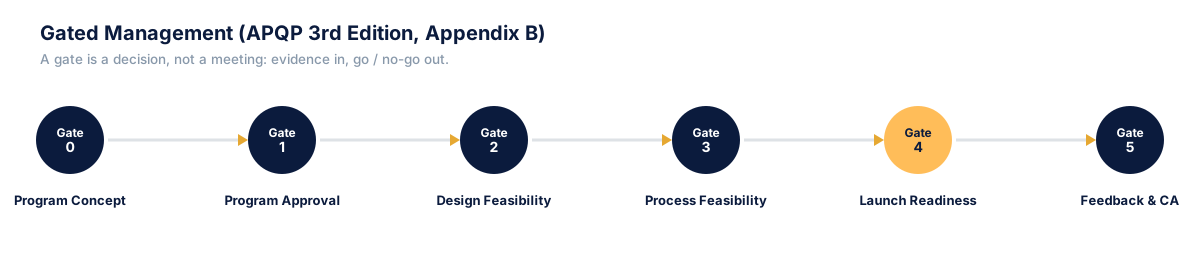
What it means for you: if your gate reviews are the always-green kind (failure mode #5), you now have a standard to rebuild them against — and your customers have a standard to audit them against.
4. Phase 1 Grows Teeth
Five additions turn Phase 1 from "collect the inputs" into genuine program due diligence:
- Capacity planning (1.13) — demonstrate the volume math before committing
- Leadership support (1.14) — named, explicit, and repeated at every phase
- Change management implementation (1.15) — how changes will be controlled, agreed upfront
- APQP program metrics (1.16) — measurable program health, not gut feel
- Risk assessment & mitigation plan (1.17) — what could sink this program, and the plan for each risk
What it means for you: quoting discipline. Most of these were "known good practice" that lost to deadline pressure; now they're line items a customer can ask to see.
5. Alignment With AIAG-VDA FMEA and IATF 16949
Terminology and concepts now match the AIAG-VDA FMEA Handbook (Action Priority instead of RPN thinking) and IATF 16949. The manual also acknowledges the world it now serves: higher automation, electrification, and expanding definitions of mobility.
What it means for you: if your FMEAs still run legacy RPN, the inconsistency is now visible across documents. Plan the AIAG-VDA migration with your APQP transition, not after it.
6. New Checklists: Risk Factors and Sourcing
Appendix A adds an A-0 APQP Risk Factors checklist (screen every program for known risk patterns at the start) and an A-9 Sourcing checklist (the supplier cascade, made explicit), alongside updated versions of the familiar design, process and control plan checklists.
7. What to Actually Do: A Practical Transition Plan
- Confirm applicability with each customer. The 3rd Edition applies "unless otherwise specified by your customer" — get it in writing per customer, don't assume.
- Gap-check your APQP procedure against the new Phase-1 elements, gated management and Safe Launch. Most procedures need a modest rewrite, not a revolution.
- Split your document references — APQP manual and Control Plan manual are now two citations.
- Pilot the gates on one live program before rolling out — gates enforced retroactively on mid-flight programs breed resentment, not discipline.
- Budget Safe Launch into your next quote. The extra containment is real money; price it in Phase 1 like the standard now expects.
Get the Complete APQP Checklist (3rd Edition)
Every phase, every deliverable, every gate — a phase-by-phase workbook with owner and status columns, aligned to the 2024 3rd Edition (including the new Phase-1 items and Safe Launch). Delivered free on WhatsApp.
Send Me the Checklist Or Request It by EmailOne closing thought from the trainer's seat: editions change, but the failure modes don't. The 3rd Edition is the manual catching up with what good plants already knew — plan capacity before you promise it, manage risk on purpose, gate with evidence, and launch with extra eyes on the process. If that's how you already run, this update is paperwork. If it isn't, the paperwork is the least of your problems — start with the fundamentals.

Dhanashree Kathare
Co-Founder, FAST Technology — writes about practical quality engineering for manufacturing teams.
Connect on LinkedIn