The AIAG-VDA FMEA Handbook (2019) harmonized the American (AIAG 4th Edition) and German (VDA Volume 4) FMEA methods into one global standard: a 7-step approach, new Severity/Occurrence/Detection tables, Action Priority (High/Medium/Low) replacing RPN, and a new FMEA-MSR analysis for mechatronic systems. If you supply both US and German OEMs, it replaced two parallel FMEA processes with one.
For twenty years, suppliers serving both Detroit and Germany lived a quiet absurdity: the same part, the same failure modes — two different FMEAs, because AIAG and VDA rated Severity, Occurrence and Detection differently. The 2019 harmonized handbook ended that. But it did much more than merge rating tables, and the changes trip up teams to this day. Here's the whole story, with a worked Action Priority example.
Why the Handbooks Merged
The project started around 2015 with a plain goal, in the project team's own words: a supplier serving both North American and German OEMs should be able to run one FMEA business process. Beyond aligning the S/O/D tables, the joint AIAG-VDA team took the opportunity to fix the method's well-known weaknesses — most famously the RPN — and to modernize it for electronics with FMEA-MSR. The result replaced both the AIAG 4th Edition and VDA Volume 4 approaches.
The 7-Step Approach
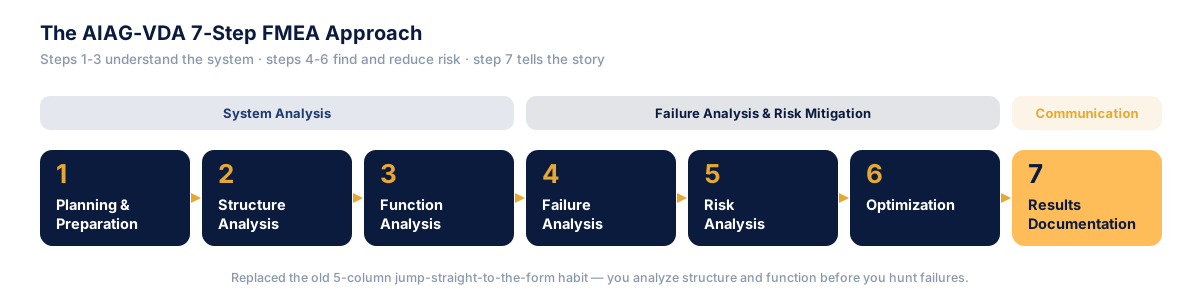
The old habit was to open the form and start filling columns. The 7 steps outlaw that: you plan the study (step 1, with the 5T — InTent, Timing, Team, Task, Tools), build the structure tree (step 2), assign measurable functions to every element (step 3), and only then hunt failures (step 4). Steps 5–7 rate the risk, drive optimization actions, and document the results.
Teams complain the front-loading is slower. It is — for the first hour. Then it pays for itself, because failure analysis against defined functions is systematic, while failure analysis from a blank form is brainstorming with a template. The full step-by-step walkthrough is on our FMEA methodology page.
Action Priority, With a Worked Example
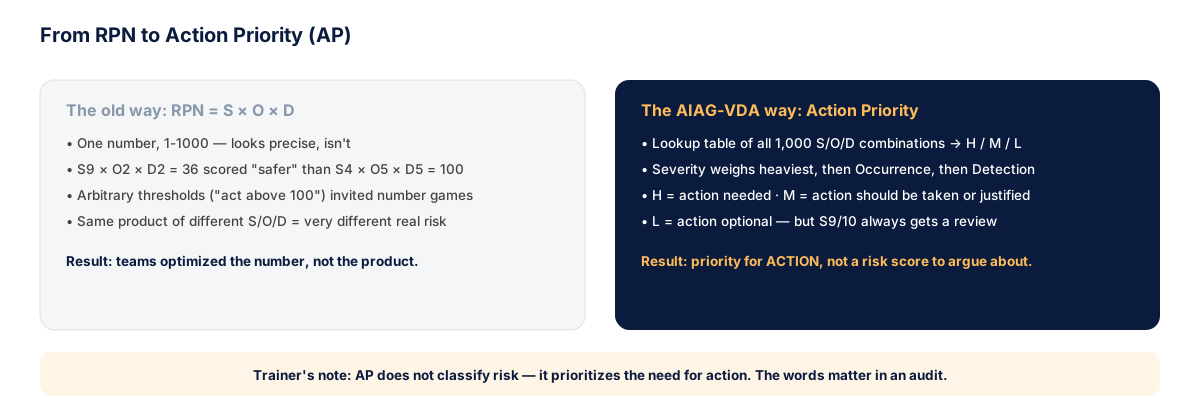
The RPN's fatal flaw was arithmetic democracy: Severity, Occurrence and Detection all voted equally. Consider two failure chains:
| Chain | S | O | D | Old RPN | Action Priority |
|---|---|---|---|---|---|
| Brake hose chafes through — loss of braking | 9 | 2 | 2 | 36 ("low") | M — and S9 demands review regardless |
| Trim clip rattles — annoying noise | 4 | 5 | 5 | 100 ("act!") | M |
Under RPN-with-a-threshold-of-100, the rattle got an action and the brake hose didn't. Every experienced quality engineer knew this was absurd; teams "fixed" it with side rules about high severity — which the AP table now builds in formally. AP reads all 1,000 S/O/D combinations from a lookup table and returns H (action needed), M (action recommended — take it or justify why not) or L (action optional), with Severity weighted first, then Occurrence, then Detection.
One wording trap that matters in audits: AP prioritizes the need for action. It is not a risk classification of the product. Say "high action priority," not "high risk," and your auditor conversation goes better.
The Other Changes Teams Miss
- DFMEA lost its classification column for special characteristics; the PFMEA kept its — special characteristics are now managed with dedicated logic between the two.
- New S/O/D tables. DFMEA Severity rates the end-user effect; PFMEA Severity rates three perspectives — your plant, the ship-to plant, and the end user. Occurrence explicitly considers prevention controls; Detection considers both capability and timing of the detection method.
- FMEA-MSR arrived — the supplemental analysis for failures during customer operation and whether diagnostic monitoring and system response keep things safe.
- Form and software expectations changed — the spreadsheet view now flows from structure / function / failure networks, which is precisely why the handbook era pushed so many teams from Excel into dedicated FMEA software.
Migrating Legacy FMEAs Without Losing Your Mind
- Don't mass-convert. The handbook does not require rewriting every historical FMEA. Migrate when a product/process changes significantly, on new programs, or when your customer asks.
- Start with families. Build one solid AIAG-VDA foundation FMEA per product/process family; derive variants from it.
- Re-rate, don't transcribe. Old ratings came from different tables — carrying numbers across without re-reading the new criteria quietly corrupts the analysis.
- Confirm customer expectations in writing. Some customers still accept 4th Edition formats on carryover parts; assumptions here are free defects later.
- Train facilitators, not just engineers. The 7 steps live or die on facilitation quality.
Get the Complete FMEA Checklist (AIAG-VDA 7 Steps)
A step-by-step workbook for running DFMEA and PFMEA per the AIAG-VDA handbook — planning 5T, structure and function prompts, failure-chain quality checks, AP follow-up and review-readiness questions. Delivered free on WhatsApp.
Send Me the Checklist Or Request It by EmailBottom line: the harmonized handbook fixed real problems — the RPN's arithmetic, the two-standard tax, the form-first culture. Teams that embraced the structure-first logic report the same thing we see in workshops: the FMEA finally finds things. Teams that just relabeled their RPN column "AP" got what they invested. For the mistakes that survive any methodology, read why FMEAs end up on shelves.

Dhanashree Kathare
Co-Founder, FAST Technology — writes about practical quality engineering for manufacturing teams.
Connect on LinkedIn